How to find the right yoga teacher?

“The most important thing is finding the right teacher – someone you relate to, someone who’s professionally trained, who keeps up with professional development and has professional risk insurance”

The above quote is from an interview with one of the past Presidents of Yoga Australia.

Finding the right yoga teacher is a bit like finding a hairdresser or car mechanic!  It has to be some connection and trust otherwise the teacher is not able to assist you to modiy the poses to suit you.

Some time ago in a yoga workshop we were asked to honour our lineage.

I would like to dedicate this blog to the teachers who shaped me as a yogi over the last 35 years and as such influenced my style.

Robin was a physiotherapist and yoga teacher.  She was treating my lower back problem and she is the one who introduced me to yoga, I will always be thankful for it!  Her classes were hard work, in those days the classes were 2 hour long and we did a lot of standing poses each class!  We also had to hold them for a long time to increase strength and stamina! We were delighted to do sitting poses after all that standing!  She wanted to teach us how to look after ourselves and she was always encouraging, saying “you are better than you think”.  She lent a sympathetic ear if a student needed it.

I used to attend Tracey’s therapy classes when I was relatively new to yoga. The therapy classes were “short” at 1.5 hours and there were less number of students.  Most of us were somewhat stiff, we knew each other’s aliments and the atmosphere / comradery in the class was very good.  Tracey paid attention to every one of us, there was no limit to the number of props she would use to support us where and when it was needed.  She is very professional, always teaches a high standard class (sequence and poses modified to suit the students and to the weather).  Tracey is also very approachable and she does a lot of self development.

Zajna playfulness and  intuition were always present. The poses we did were unique and the sequencing too!  From one twist through squatting to another twist! How did she come up with this?  The answer was simple: she loved her yoga and she practiced at home and shared her discoveries with us.  Her descriptions were colourful.  At one time she said to a pregnant student “it is good for the baby to see that you are folding up the blanket nicely!”  Zajna loved her food and cooked with the same confidence as she taught yoga.

Helena took over Zajna’s Saturday classes and I continued to attend.  This brings in some other considerations when choosing a yoga teacher:

  • location (either close to work, to home or shopping, i.e. fits in with your lifestyle)
  • time of class

Helena introduced me to the “monthly cycle” of the Iyengar method where each week is spent on practicing a particular family of poses.  This  cycle aims at achieving a balanced practice.  Helena is very good with adjustments.  The atmosphere in her classes is jovial and the students are regulars.

Nowadays there is an abundance of different styles of yoga, we need to respect each other’s preference and be united by the love of yoga.

In conclusion: finding the right yoga teacher is a bit like finding a hairdresser or car mechanic!

How is “yoga over 50” different?

lotus yoga

With my lower back problem I always knew that I will teach yoga with gentle movements, no advanced poses and no jumping.

My students are around my age, baby-boomers with some pre-existing conditions.

Due to the over 50′ label new students start with telling me their age.  I reassure them that I won’t ask for their birth certificate and during my 35 years of practicing yoga I have learnt how to modify the poses to suit the individual.

The question I am aiming to answer is “how is yoga over 50 is different (from other yoga)?”

Our classes are gentle in comparison to the dynamic ashtanga / power or yang yoga practices.  Gentle means that we might go a bit slower (have a rest anytime you need to).  When it comes to inverted poses we do the preparation for headstand and shoulder stand instead of the full version.  Due to the higher number of medical conditions in the class we might have more than two variations for a pose – so every student can practice safely on their own level.

In my view our attention to detail exceeds what I have seen in big “general” classes.  If we go into balancing standing poses with grace (i.e. hands on the wall until we feel secure standing on one leg) we stand straighter than a lot of people half of our age!

For an ageing / stiffer body it takes a bit longer to warm up so we start by warming up all of our joints (neck, shoulders, fingers, hips, knees, ankles and toes).  With the colder weather we experience cramps more often than in summer and more often than the younger generations.  This could indicate that we might not stretch enough or we have magnesium deficiency.

In my class we use a lot of props (blocks, belts, bolsters, blankets and chairs) which reflects more my Iyengar style practice than the age of the students.

Most of us have passed the “working long hours and exhausted all the time” stage in our lives and no one falls asleep during the relaxatoin (Savasana) at the end of the class.  We enjoy our tranquillity!

There is more and more medical research and evidence into the health benefits of yoga, including how it slows down the ageing.

Apart from the stretching and strengthening exercises yoga requires and improves concentration, stamina, reduces stress and some students appreciate the social aspect of practising together with likeminded people. There is no difference whether you are young or over 50!

In summary:

I believe if a yoga class is marked for over 50’s, seniors or golden yogis – it is suitable for anybody who wants to practice in a small class with a senior teacher who most likely has seen a lot on the mat and off the mat.

People of all ages and with various pre-existing conditions (or recovering from injury or operation) would benefit from attending these classes.  Students who new to yoga could learn the basics before joining in faster paced classes.  Once you know how to do a pose safely you can prevent injuries.

I would almost promote the over 50’s classes as a type of therapy class!

Keep up and enjoy your practice!

Namaste

Mary

yoga mat

Why do New Year’s resolution fail?

Several years ago I spent New Years Eve at Mangrove Yoga, which was a working ashram at the time.  Their teachings followed the Satyananda tradition. The wisdom from the night has stayed with me and I would like to share.

I was looking forward to the the fire ceremony, chanting, yoga classes, yoga nidra and good vegetarian food – and all my wishes were fulfilled.  

We were sitting on mats under the stars on a beautiful summer night.  One of the senior swamis asked the question: Why do New Year’s resolution fail?

nye2016123

WHY DO NEW YEAR’S RESOLUTIONS FAIL?Continue reading “Why do New Year’s resolution fail?”

Twists – to remove sluggishness and to energize the body


Do you feel irritable, sluggish, even depressed or anxious in the morning?

This could be due to the change of seasons, from winter to spring.  Yoga poses, especially twists are very beneficial as they move the energy around the body, they help to trim down, create space in the spine and also useful in the management of scoliosis. Continue reading “Twists – to remove sluggishness and to energize the body”

Improve your posture – stand tall

Posture is the way in which you hold yourself while sitting, standing, and lying down. Good posture is important to allow our organs to work better, think of your lungs. We all spend too much time sitting and tend to hunch our shoulders.

Do an easy test: stand with your back and head against a wall. Bend your arms so you have your elbows to the side, in line with your shoulders. See if you can bring the elbows to the wall. If yes, your spine is long and have good range of movement in your shoulder.

Below are a few poses you might want to practice to improve your posture.

  1. The ‘Cat and Cow’ pose is regularly included in warm up sequences.

Start with kneeling on all fours. After emptying the lungs on the next inhalation open the chest and lock up. When you exhale round your back, bring the head in to look towards your naval and bring the tailbone in. The breath is longer than the movement, soft breathing. Visualise the whole spine – from the neck to the tailbone. This pose creates space between the vertebraes.

2. Whilist you are kneeling try the following balancing pose. Start with extending one arm in front of you, then the other. Then raise one leg up to hip height, bring it back and raise the othe leg. Think of extending from your core. This pose is included in most classes for seniors and a modified version can be done sitting on a chair.

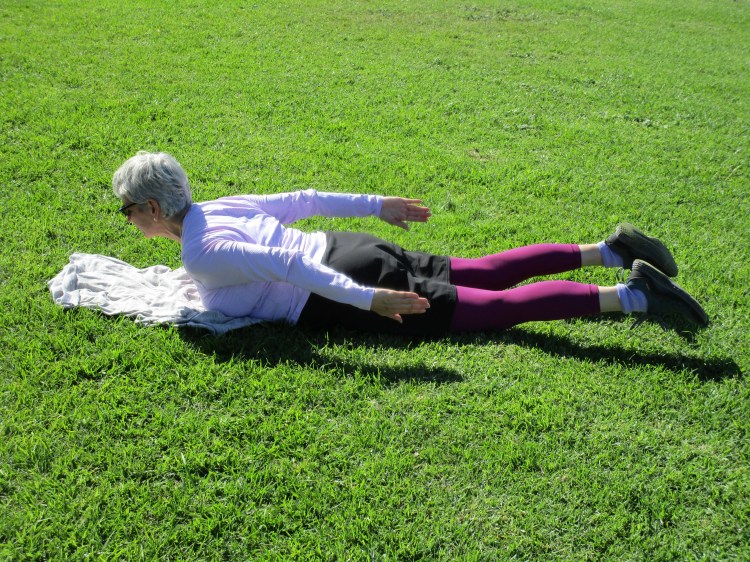
3. The locus pose below is a backbend which opens the front body and lengthens to lower back. Start laying on your abdominal, rest your forehead on the mat and keep your arms on the mat parallel to your torso. On inhalation extend the throat and raise your head and chest. Keep your feet on the floor, toenails will help you to balance. When breathing out bring the chest and head back to the floor.

Keep the chest on the floor and on an inhalation raise one leg. Try not to roll onto the opposite hip. When you breath out, bring the leg back to the floor. Repeat on the other side.

If you are able, now try to raise the arms and the legs at the same time. Breathing smoothly hold for a few cycles of your breath then bring the arms, legs, torso and head back to the floor. For a resting pose turn your head to one side, allow the shoulders to soften.

People with lower back issues do not come up very high.

If you don’t have lower back issues try a more advanced option where the arms are exteneded in front of you.

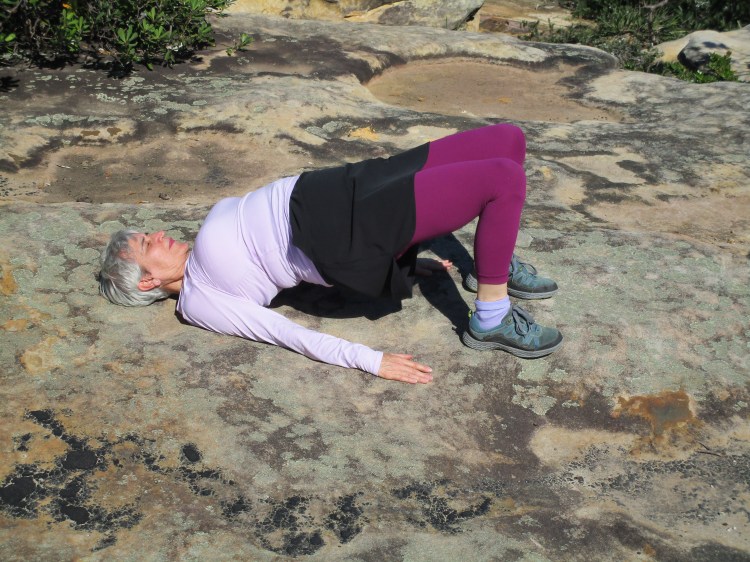
4. The bridge pose below has a number of benefits. Firstly it opens chest, lengthens the lower back and works your legs. Start with laying on the mat with bent legs. Ideally you want the feet to be as wide as your hips. Slightly tuck your chin in, walk your shouldblades in a bit. On inhalation take the tailbone towards your heels and lift your torso. Once you are up please do not turn your head and work the legs. On exhalation come down. After doing this a few times (i.e. in and out of the pose) hold the pose for a number of cycles of breath, up to 10. To release the lower back bend the legs towards your chest and do a few small circles one direction and the other.

The last thing I would like mention is: breath effectively. It is easy observe when you lay down. Notice how the breath travels from your abdominal are to the thorasic area and then to the upper chest. The abdominal area expands on inhalation and falls back on exhalation, the ribcage expands sideways and up as you inhale and there is some movement around the clavicles.

With all these four poses, over a period of time, increase the number of cycles you do and you will notice the improvement.

An ageing body requires a fair bit of maintenance but the stakes are high – to be able to participate in the activities we love.

Enjoy your practice!

Trimming down with yoga

With the Festive Season behind us we might notice that our waistline has expanded. If one of your New Year’s resolution is to improve your health please read on :)!

As we age it easier to put on weight, the metabolism slows down so we need to watch the energy intake and output more closely.  Hormones also affect how and where we store fat on our body.

My aim is to show you a variety of poses which lengthen the spine and make you move around the waist.

Continue reading “Trimming down with yoga”

Cancer and yoga

Noone wants to hear the diagnosis which starts with C, for Cancer.

Sadly, close to 160,000 persons received this news in Australia in 2022.  With the improvements of treatment options the relative survival rate (living for more than five years) is on the rise. The probability of developing cancer increases as we age, most noticeably over 60.

The ongoing treatment leaves most patients fatigued, maybe depressed and / or anxious. There are also challenges with cancer survivorship, adjusting to a new lifestyle.

Cancer Council NSW has lots of information on the various types of cancers, support networks etc. One of their booklets is titled “Complimentary Therapies”. In that Mindfulness, Relaxation and Meditation and Yoga are listed as evidence-based modalities.

Yoga aims to unite the Mind, Body and Spirt and is a philosophical science, consisting of eight limbs or stages. The poses are the 3rd limb, breathwork is 4th and through one pointed attention we arrive to meditation.

Benefits of yoga for during cancer treatment:

There is evidence that yoga has positive effects on decreasing stress and anxiety, reducing sleep disturbance, improving muscle strength and mobility. The focus on breath may also help to reduce pain.

The key is to establish a regular practice, even if it is a few minutes per day.

Another great benefit of yoga that it is portable, can be practiced almost anywhere (think of using a bench in a park).

How is a yoga class for persons with Cancer?

The classes are sequenced similarly to general classes, there is warm up, energising / refining and finishing (relaxation, maybe with a short guided meditation).

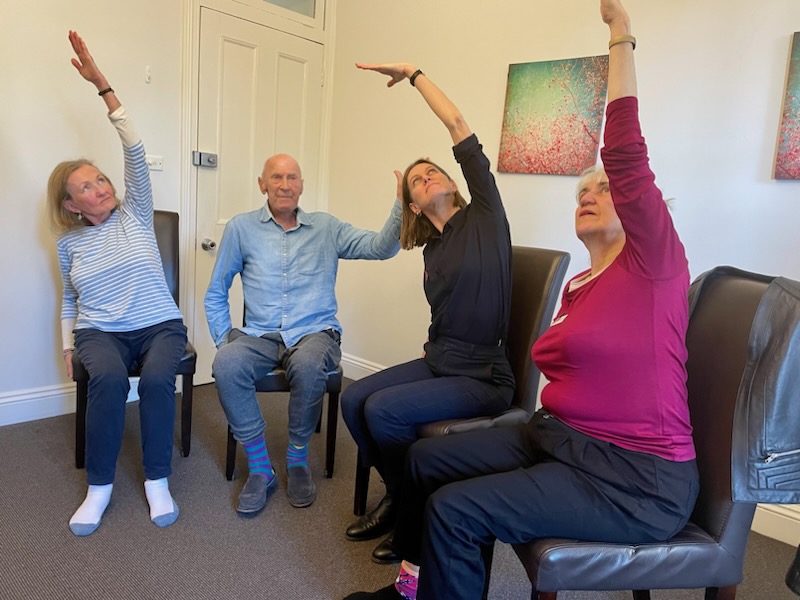
We start the class with chair yoga (which is an accessible form of yoga suitable for people injured or recovering from operation or treatment) and might include some standing poses, using the chair for better balance. The aim is to move with the breath.

Often people with cancer have other pre-existing medical conditions. It is therefore important that the yoga teacher is experienced in modifying the poses for the individual.

Simple breathing techniques, such as slowing down the exhalation helps to calm down the overactive, stressed mind.

Expression of interest thought:

Please contact me by email if you are interested in participating in a small, chair yoga class in Bondi Junction (Sydney) area. To teach you better, you will need to have one individual class with me before joining the class.

Photos of our last cancer workshop – with permission from the group.