

Posture is the way in which you hold yourself while sitting, standing, and lying down. Good posture is important to allow our organs to work better, think of your lungs. We all spend too much time sitting and tend to hunch our shoulders.
Do an easy test: stand with your back and head against a wall. Bend your arms so you have your elbows to the side, in line with your shoulders. See if you can bring the elbows to the wall. If yes, your spine is long and have good range of movement in your shoulder.
Below are a few poses you might want to practice to improve your posture.
- The ‘Cat and Cow’ pose is regularly included in warm up sequences.
Start with kneeling on all fours. After emptying the lungs on the next inhalation open the chest and lock up. When you exhale round your back, bring the head in to look towards your naval and bring the tailbone in. The breath is longer than the movement, soft breathing. Visualise the whole spine – from the neck to the tailbone. This pose creates space between the vertebraes.

2. Whilist you are kneeling try the following balancing pose. Start with extending one arm in front of you, then the other. Then raise one leg up to hip height, bring it back and raise the othe leg. Think of extending from your core. This pose is included in most classes for seniors and a modified version can be done sitting on a chair.

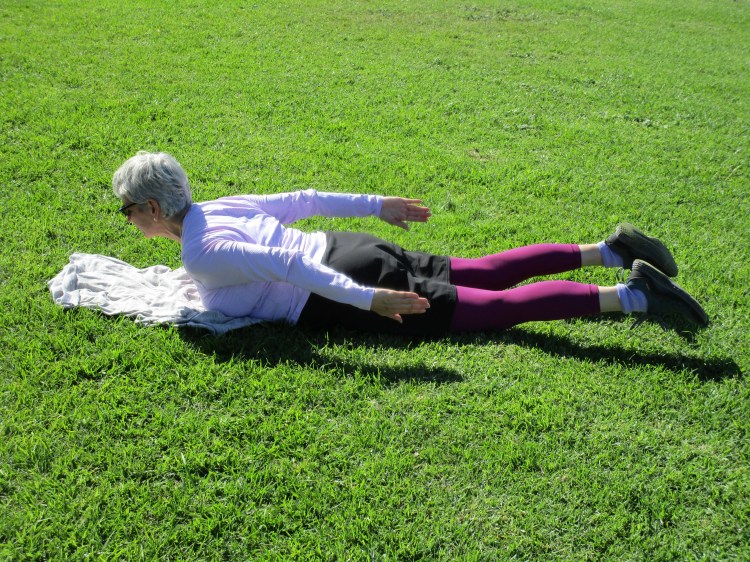
3. The locus pose below is a backbend which opens the front body and lengthens to lower back. Start laying on your abdominal, rest your forehead on the mat and keep your arms on the mat parallel to your torso. On inhalation extend the throat and raise your head and chest. Keep your feet on the floor, toenails will help you to balance. When breathing out bring the chest and head back to the floor.
Keep the chest on the floor and on an inhalation raise one leg. Try not to roll onto the opposite hip. When you breath out, bring the leg back to the floor. Repeat on the other side.
If you are able, now try to raise the arms and the legs at the same time. Breathing smoothly hold for a few cycles of your breath then bring the arms, legs, torso and head back to the floor. For a resting pose turn your head to one side, allow the shoulders to soften.
People with lower back issues do not come up very high.
If you don’t have lower back issues try a more advanced option where the arms are exteneded in front of you.
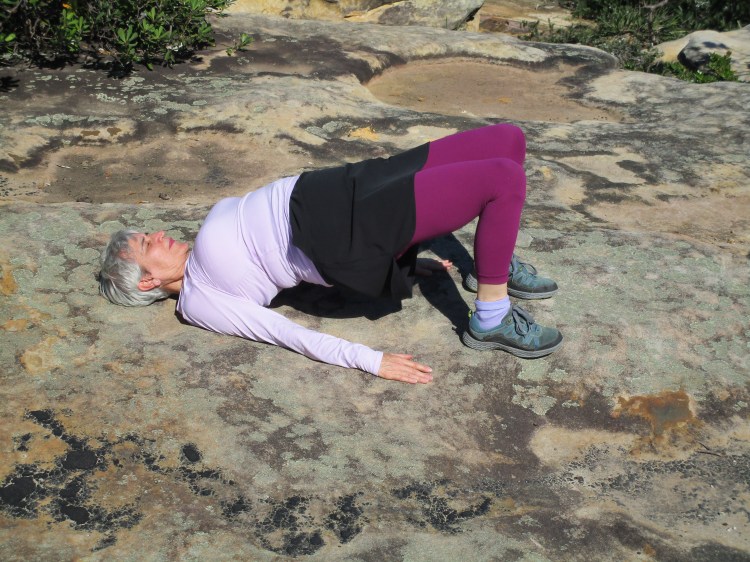
4. The bridge pose below has a number of benefits. Firstly it opens chest, lengthens the lower back and works your legs. Start with laying on the mat with bent legs. Ideally you want the feet to be as wide as your hips. Slightly tuck your chin in, walk your shouldblades in a bit. On inhalation take the tailbone towards your heels and lift your torso. Once you are up please do not turn your head and work the legs. On exhalation come down. After doing this a few times (i.e. in and out of the pose) hold the pose for a number of cycles of breath, up to 10. To release the lower back bend the legs towards your chest and do a few small circles one direction and the other.
The last thing I would like mention is: breath effectively. It is easy observe when you lay down. Notice how the breath travels from your abdominal are to the thorasic area and then to the upper chest. The abdominal area expands on inhalation and falls back on exhalation, the ribcage expands sideways and up as you inhale and there is some movement around the clavicles.
With all these four poses, over a period of time, increase the number of cycles you do and you will notice the improvement.
An ageing body requires a fair bit of maintenance but the stakes are high – to be able to participate in the activities we love.
Enjoy your practice!


